🔑 Key Takeaways
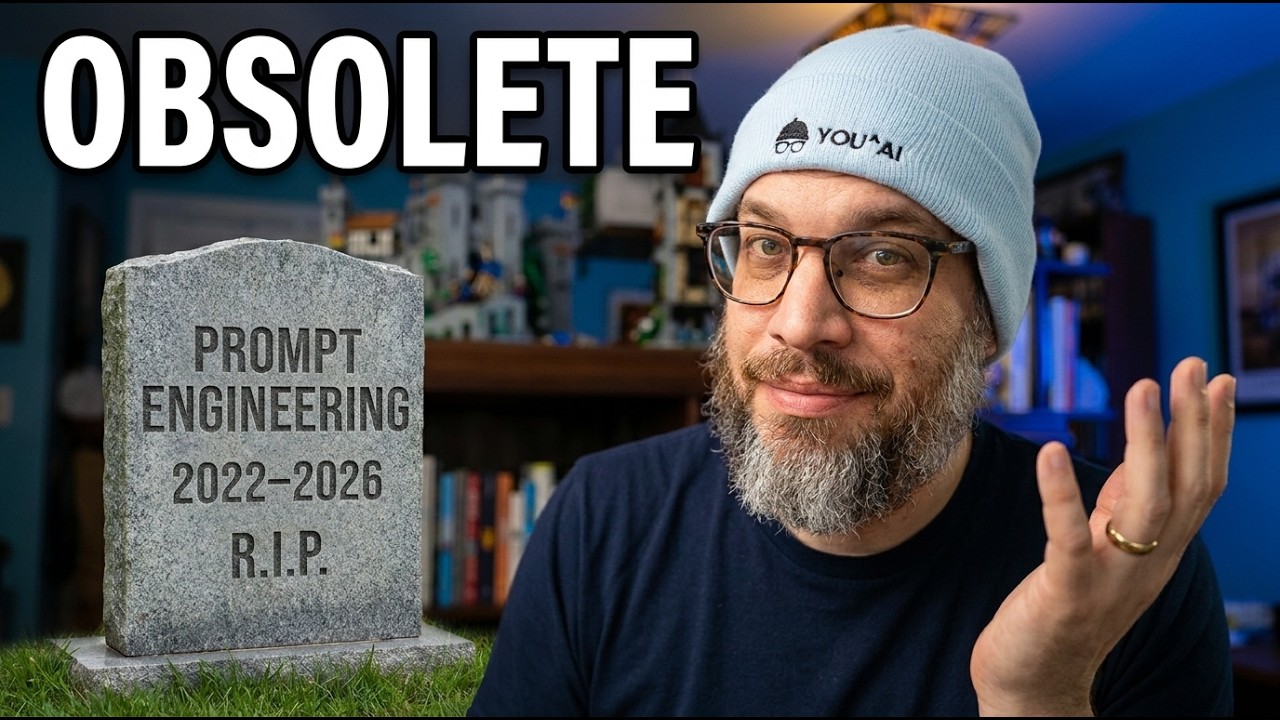
- Prompt engineering is table stakes — necessary but no longer a differentiator. The new skill is asking great questions.
- Agents are now ~100x more powerful than 6–8 months ago (better tool use, longer sessions, larger context).
- Mental model shift: AI = senior partner, not junior assistant.
- Three principles of the AI Question Method:
- Flashlight Intent — convey the center of your focus AND the edges.
- Multi-Directional Synthesis — ask questions that force AI to synthesize across complex dimensions.
- Data + Opinion Breadth — ensure AI engages with ALL data sources and knows your thesis across them.
- You can prime AI memory to remind you when you fall back into flat, directive prompting.
00:00 Prompt Engineering Is Dead — Long Live It
Nate opens provocatively: "Prompt engineering is a 2025 conversation." He acknowledges the eye-roll — people feel prompting is passé because "you can just ask AI and it works." But his point is nuanced: prompt engineering skills are now baseline requirements. You don't get credit for them anymore.
"Yes, absolutely true. It's table stakes now. It is table stakes now. You got to be good at it. You don't get credit. Sorry. Welcome to the way AI moves."
He notes that even people at AI labs say "just ask for what you want" — but this only works when people actually know what they want. For complex agentic knowledge work, most people don't.
01:00 The 100x Agent Leap: What Changed with 4.7 & 5.5
Claude Opus 4.7 and OpenAI o5.5 (released in the prior ~2 months) represent a qualitative shift:
- Better tool calling and data retrieval
- Ability to work for much longer periods
- Dramatically expanded scope of corporate impact
Nate frames this as a 100x improvement in agent power — but our prompting style has NOT evolved 100x. That gap is the core problem.
07:12 He notes a "second acceleration" since these launches, particularly with o5.5 in Codex, making the question-based approach more viable than ever.
02:33 The AI Question Method — A New Mental Model
Nate introduces the "AI Question Method":
You ask → you get an answer. Transactional. Task-based. You define every detail.
Partnership, exploration, co-thinking. You form questions that enable the agent to do its best work.
"We are really in a question world, not a prompt world."
03:03 Senior Partner vs. Junior Partner
THE biggest mental model shift for 2026:
Be very specific, careful, prescriptive. Define every step.
Share context, ask questions, trust its judgment, let it push back.
When you treat AI as a senior partner, you unlock its full capabilities. When you micro-manage it like a junior, you constrain it.
03:38 The Good Manager Story
From Nate's time on a marketing team at Amazon, his manager would:
- Share the problem space openly: "I need you to dig into this"
- Provide raw materials: CSVs, Excels, context
- State the goal: marketing attribution → deck + doc for leadership
- Set quality standards: "clear, incisive, tells a real story"
- Leave room for autonomy: "I'm going to leave a lot to you"
- Guide with questions along the way
04:41 That same management approach now looks exactly like a good agentic prompt in 2026.
05:17 Defining "Agents" for This Context
Heavy knowledge work in Claude Code, Co-Work, Codex. Deep partnership thinking with frontier models. Unique, custom, creative problem-solving.
Agentic pipelines (customer service tickets, invoice processing). Defined, predictable workflows. Need evals & structured testing.
09:09 Principle #1: The Flashlight — Intent with Edges
Your questions need a "center of the flashlight" and visible edges.
🔦 Center = Your thesis / perspective / angle
"Help me learn more about the Mona Lisa"
"I have a thesis that painting the Mona Lisa shaped Da Vinci's relationships late in life. Investigate from that angle."
🔲 Edges = Boundaries & exclusions
11:18 Example: Meeting notes → report, but 15 min was about an unrelated project. Explicitly: "Excise that. Do not include the greenlighting discussion."
Common Mistakes
- Overly open-ended questions (no center)
- Overly closed questions (no room to explore)
- Missing edges (AI wanders into irrelevant territory)
12:51 Principle #2: Invite the AI to Synthesize Across Complex Questions
Ask the AI to consider what "good" looks like in a more open-ended way than writing an eval. Evals are great for pipelines — but for creative knowledge work, you need the AI to explore quality.
Worked Example — PR/FAQ Document
14:06 Fictional scenario: Prime Video launching 3D holographic soccer players for the World Cup.
- Question 1: "How is this accessible whether someone has had a 3D experience before or not? How do we convey that in the press release?"
- Question 2: "Think about the interrelationship between software and hardware — convey emotion in the press release AND list technical seamlessness in internal FAQs."
"I did not say THIS is how I want it woven together... I asked the AI to wrestle with me on it and think it through and come back."
15:58 "I'm not seeing people doing it. I'm not seeing people actually say, let me ask multiple open-ended questions and let the AI synthesize across."
17:22 Principle #3: Data Breadth + Your Opinions
Ensure the AI engages with ALL your data sources while knowing your opinions across them.
The Working Context Folder
17:51 Nate's Codex workflow: have the AI organize files into a single working context folder:
- Formal files: docs, PowerPoints, Excel, code
- Informal files: meeting transcripts, notes
The Problem
18:18 People assume AI will uniformly dig into all files. It often doesn't — your question inadvertently angles it toward one file and it dives deep there while ignoring others.
The Fix
Ask questions that explicitly reference the breadth of data and convey your opinions across that breadth, so the AI has reason to engage with every source.
19:57 Worked Example: MRR Product-Led Growth Analysis
A full example combining all three principles.
Setup
- Goal: Increase MRR (Monthly Recurring Revenue)
- Data: Voice of customer transcripts, support tickets, PRDs, launch announcements, analytics
- All organized into one folder
The Question
"My thought is that our product-led growth angle from the last two years is broken. I don't think we're getting good margin. I think that shows up in flatter MRR growth over the last 6 months, in dead-cat-bounce launches, and in our own thinking in the PRDs. Look across ALL the data. Come back with YOUR thesis. You don't have to agree with me. But it needs to be the cleanest, most explanatory thesis you can find — so we can partner to decide what to launch next and why."
Why This Works
- ✅ Flashlight intent — PLG is broken (center of the beam)
- ✅ Edges — specific data artifacts named (MRR, launches, PRDs)
- ✅ Synthesis — invites AI to agree OR disagree
- ✅ Data breadth — explicitly says "look across ALL data sources"
- ✅ Senior partner — "you don't have to agree with me"
Anti-Patterns Nate Sees
- ❌ Flat prompts that list data without intent or questions
- ❌ Wild rambling opinions where AI just mirrors you back
- ❌ No invitation for AI to push back or explore independently
23:29 Closing: The Future of Prompting
- AI memory: You can prime AI to remind you when you're not asking thoughtful questions. It will nudge you back into question mode.
- "We need to find a new word for the future of prompting."
- The words were never what mattered most — the INTENT was always the key. Intent is now best expressed as a sharp series of questions.
"Take this transcript, chat with AI about it. See if that sparks something. And have fun."